



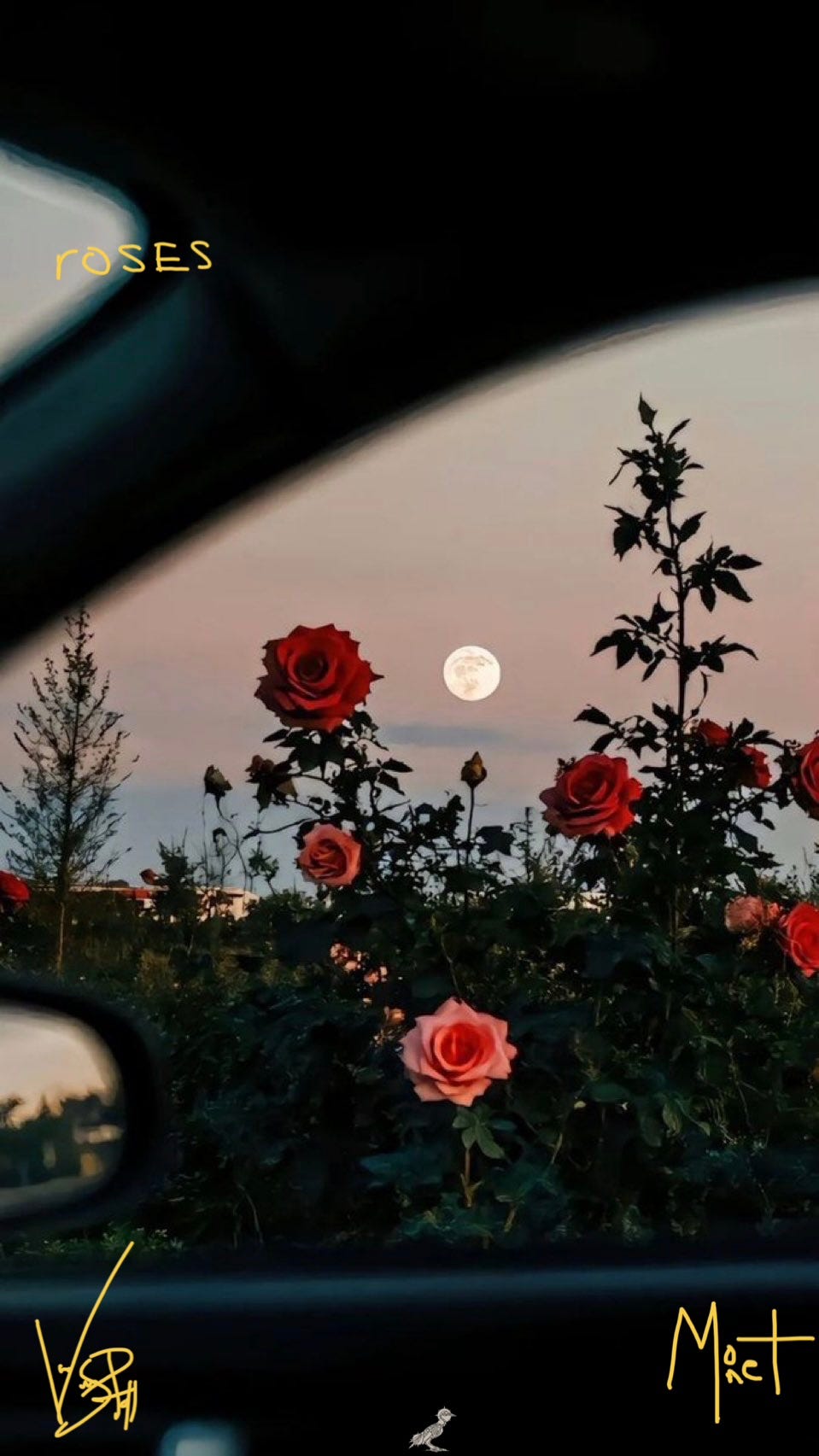
ROSES: The Complete Correspondence
An Elegiac Rebuttal in Two Cantos by Walden Molkeb II
Written by Walden Molkeb II
Performed on MDNTMRKTVOX
Published by MDNT MRKT PERENNIAL × MDNTMRKT PRESS
After the philosophical debates, intimate confessions, psychoanalytic interpretations, and literary criticism of ROSES: The Complete Correspondence, Walden Molkeb II offers no correction.
He plants a garden.
Part II leaves behind letters, diagnoses, and architecture, carrying the entire correspondence into an ominous September across the pastoral farmland of Connecticut, where every participant becomes another species of rose growing beneath the certainty of approaching frost.
This is not an appendix.
It is an elegy.
Episode Synopsis
“The Roses Do Not Answer” transforms the correspondence into a living landscape.
Monet Marcel by Delray becomes the rose stretching beyond the stone wall, unable to keep affection from spilling into the path of strangers.
Iridescent becomes the bloom beneath the farmhouse window, nourished differently, growing beneath altered light, asking readers to distinguish privacy from absence.
Oulette stands where cultivated garden meets open pasture, revealing that relationships sometimes change not because two people discover new language, but because a third presence quietly alters the geometry of the entire room.
Dr. Penton Myers-Marc appears as the careful gardener, pruning unhealthy growth while learning that structure cannot protect every blossom from weather.
Dr. Vivian Storenbend Potts becomes the stone wall itself, preserving interiority while asking difficult questions about who owns the room and who has historically been permitted to enter it.
Mitchell Cunningham restores names to fading botanical markers, translating loneliness without pretending language alone can heal it.
Finally, David Foster Wallace appears not as biography or literary monument, but as the final diseased rose still flowering despite impossible conditions, reminding us that visible beauty never proves invisible wholeness.
Direct Commentary
Rather than deciding who was correct throughout the correspondence, Walden dismantles the very impulse toward verdict.
He argues that every participant has mistaken a partial truth for complete architecture.
The house is necessary.
The room is necessary.
The road is necessary.
The lock is necessary.
The knock is necessary.
The unanswered silence is necessary.
No single metaphor survives untouched.
Instead, Walden proposes a radically ecological understanding of relationship.
Like roses, people require conditions.
Like gardens, relationships demand maintenance.
Like September, love simultaneously contains abundance and disappearance.
The central metaphor shifts from communication to cultivation.
One cannot love a rose into blooming.
One cannot diagnose it into health.
One cannot theorize frost away.
One can only learn the conditions under which growth remains possible.
Themes Explored
Pastoral elegy
Connecticut farmland as emotional landscape
Roses as relational ecology
Weather as psychological atmosphere
Hospitality versus ownership
Solitude versus disappearance
Reader-response theory in lived relationships
The ethics of metaphor
Queer intimacy
Recovery after addiction
Maintenance as love
The burden of interpretation
Emotional translation
Human interdependence
Mortality and impermanence
September as literary symbol
Why This Reading Matters
Where Part I asked whether two people could understand one another, Part II asks a quieter question:
Must understanding always come before love?
Walden’s answer is startlingly simple.
No.
Love survives not because every mystery becomes solved, but because some mysteries are permitted to remain mysteries without becoming accusations.
The roses never answer the correspondence.
They bloom.
They decay.
They return through root rather than memory.
Humans, by contrast, remember because they cannot return unchanged.
Featured Literary Influences
Virginia Woolf
David Foster Wallace
Sam Walter Foss
Rainer Maria Rilke
Wendell Berry
John Berger
Gaston Bachelard
Martin Buber
Roland Barthes
Cormac McCarthy
Closing Reflection
“The Roses Do Not Answer” ultimately refuses the fantasy that every relationship must arrive at resolution.
Instead, Walden offers a gentler possibility:
People may remain unfinished.
Love may remain incomplete.
The conversation may never fully conclude.
And yet…
Someone still sets another place at the table.
Someone still shakes the rain from the heaviest blossom.
Someone still opens the door before anyone knocks.
Perhaps that has always been enough.
📖 Read the complete epistolary novel
ROSES: The Complete Correspondence
https://pdflink.to/roses/
🎙 Listen to MDNTMRKTVOX
The official spoken-word and literary criticism podcast from MDNT MRKT CONT, featuring dramatic readings, original fiction, literary essays, criticism, poetry, and conversations exploring contemporary literature, recovery, philosophy, queer identity, and independent publishing.
SEO Keywords
ROSES • Walden Molkeb II • MDNTMRKTVOX • Epistolary Novel • Pastoral Elegy • Connecticut Literature • Literary Podcast • Spoken Word • Virginia Woolf • David Foster Wallace • Sam Walter Foss • Reader-Response Theory • Psychoanalytic Criticism • Queer Literature • Recovery Writing • Independent Publishing • Literary Fiction • Roses Symbolism • September Poetry • Emotional Translation • Contemporary Literature • Detroit Writers • MDNT MRKT CONT
Hashtags
#ROSES #TheRosesDoNotAnswer #WaldenMolkebII #MDNTMRKTVOX #MDNTMRKTCONT #EpistolaryNovel #PastoralElegy #SpokenWord #LiteraryPodcast #VirginiaWoolf #DavidFosterWallace #SamWalterFoss #ReaderResponseTheory #PsychoanalyticCriticism #QueerLiterature #RecoveryWriting #SeptemberRoses #ConnecticutPastoral #IndependentPublishing #DetroitLiterature #LanguageOfLoneliness #ContemporaryPoetry #LiteraryCriticism #ProsePoetry #ExperimentalLiterature 🌹


